
Storing And Reconstituting A Three-Component Peptide Blend: Why GLOW Adds Complexity


Written By: Gary Hite, Research Content Writer
Reviewed By: Natalie Kunsman, M.D., Board-Certified Physician
Last Reviewed: August 30, 2026
GLOW is a research blend that combines three distinct peptides inside a single vial. For laboratories that handle multi-peptide preparations, that one design choice reshapes almost every step of the storage and reconstitution workflow. A blend is not three separate compounds sitting quietly side by side. It is one preparation whose overall stability is governed by its most sensitive ingredient. This article walks through the practical handling considerations that come with a three-component blend, from cold chain storage of the lyophilized powder, through reconstitution technique, to the concentration math that trips up many bench workflows.
Disclaimer: GLOW and all individual compounds referenced in this article, including GHK-Cu, BPC-157, and TB-500, are intended strictly for in vitro laboratory research and educational purposes only. These materials are not drugs, supplements, cosmetics, or foods. They are not for human consumption, not for animal consumption, and not for any diagnostic, therapeutic, or clinical application. Nothing in this article constitutes medical, scientific, or professional advice, nor any claim regarding safety, efficacy, or biological activity. Handling, storage, reconstitution, and laboratory work involving research compounds should be carried out only by qualified professionals in an appropriate research setting and in full accordance with all applicable laws, institutional policies, and safety regulations.
What Sits Inside a GLOW Blend
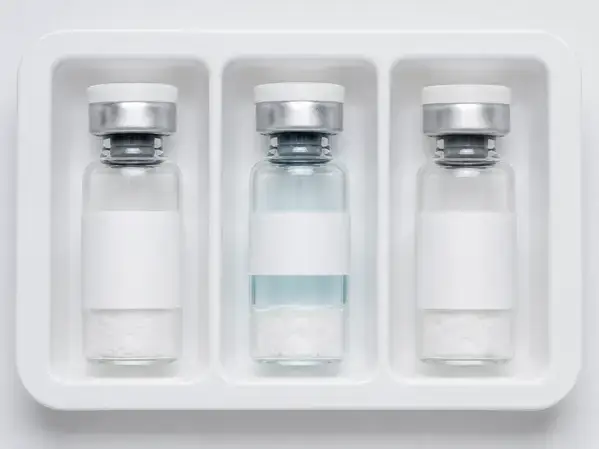
GLOW typically refers to a three-component research blend built from GHK-Cu, BPC-157, and TB-500. Each is a separate research peptide with its own molecular characteristics, and that variety is the entire reason a blend behaves differently from a single peptide vial.
GHK-Cu is a copper bound tripeptide. The copper complex gives the reconstituted material a characteristic faint blue tint and introduces oxidation and light sensitivity considerations that pure peptides do not carry. BPC-157 is a short synthetic peptide commonly stocked as a research reference material. TB-500 is a synthetic peptide fragment used in laboratory work as a reference compound. Because the three differ in size, charge, and chemical makeup, they do not necessarily respond in identical ways to the same temperature, light, or diluent conditions. Treating the blend as if it were one uniform substance is where most handling errors begin.
Why Three Components Multiply the Storage Variables
With a single peptide, you protect one stability profile. With a blend, you are protecting three at once, and the practical rule is simple: the stability of the whole preparation is set by its least stable member. If one component degrades faster under warmth or light, the blend as a research material is only as reliable as that weakest link.
Several variables drive peptide stability in any vial, and each is amplified in a blend. Temperature controls the rate of chemical breakdown. Light exposure can accelerate degradation, and the copper component raises that sensitivity further. Moisture is the enemy of any lyophilized powder, since trapped humidity invites hydrolysis. Repeated freeze and thaw cycles stress peptide structure each time the material crosses the freezing point. The pH and quality of the chosen diluent influence how cleanly the material goes into solution and how long it stays intact afterward. A researcher planning storage for GLOW has to satisfy the strictest requirement among all three components rather than averaging them out.

Storing the Lyophilized GLOW Powder
Sealed lyophilized powder is the most stable state the blend will ever be in, so the goal is to keep it in that state as long as possible. For extended storage, keep the unopened vial in a freezer at around minus 20 degrees Celsius, and colder is preferable for long horizons. Short working periods in a refrigerator at 2 to 8 degrees Celsius are common for material in active rotation, but freezer storage protects the blend over the long term.
Light and humidity deserve specific attention. Store vials away from direct light, and keep any included desiccant in place. A frequently overlooked mistake is opening a cold vial in a warm, humid room, which lets condensation form on and around the powder. Allow sealed vials to reach room temperature before opening so moisture does not settle on the lyophilized pellet. Above all, minimize temperature cycling. Every trip in and out of the freezer chips away at stability, and a blend pays that cost across three components rather than one.

Reconstituting a Three-Component Blend Without Damaging It
Reconstitution is where technique matters most, because rough handling can degrade peptides before any research work even begins. Bacteriostatic water is a common diluent for laboratory reconstitution of research peptides, and the method matters as much as the choice of diluent.
Use this sequence as a working guide for a research preparation:
- Bring both the vial and the diluent to a stable, controlled temperature before combining them, so the blend is not shocked by a sudden swing.
- Add the diluent slowly, directing the stream down the inner glass wall of the vial rather than blasting it straight onto the powder pellet. A gentle stream protects fragile peptide structure.
- Do not shake the vial. Swirl it gently or let it stand, since vigorous shaking creates shear forces and foaming that can damage peptides and pull copper containing material out of clean solution.
- Give the blend time to dissolve fully. Three components with different solubility behavior may not clear at the same rate, so patience prevents an under dissolved working stock.
- Inspect the result. A faint blue tint is consistent with the copper component, but cloudiness, visible particulates, or undissolved material signals that the preparation needs more time or attention before use.
Cleanliness throughout this process protects both the material and the integrity of any downstream research.
Working Out Concentration for a Blended Vial
This is the step that separates a blend from a single peptide and where many workflows stumble. Concentration is mass divided by volume, which is straightforward for one compound. For a blend, you have to decide whether you are calculating total peptide concentration or the concentration of one specific component, because those are not the same number.
Suppose a vial contains 30 mg of total blend material and a researcher adds 3 mL of sterile diluent. The combined concentration across all three peptides is 10 mg per mL. If the blend is formulated in roughly equal parts, each individual component sits near 3.33 mg per mL within that same solution. An investigator who needs one specific component at a defined working concentration has to begin from the per component mass listed on the certificate of analysis, not from the combined total printed as a headline figure. The practical habit is to decide the target concentration first, confirm the per component breakdown from the documentation, then back calculate the diluent volume needed to land on it. Building a working stock around the combined number alone is a common source of error in blended preparations.

Stability and Aliquoting After Reconstitution
Once a peptide is in solution, it is far less stable than it was as a dry powder, and a blend inherits the shortest usable window among its three members. Reconstituted material belongs in refrigeration and should be used within a limited time frame rather than left out.
Aliquoting is the most effective protection against degradation. Dividing the reconstituted blend into single use portions means you thaw only what a given experiment requires and spare the rest from repeated freeze and thaw stress. Label every aliquot clearly with the blend name, the calculated concentration, the lot number, and the reconstitution date. Clear labeling is not bureaucracy. It is what keeps reproducibility intact when several preparations share a freezer, and it lets any researcher confirm at a glance whether a working stock is still within its reliable window.
Common Handling Mistakes With Peptide Blends
A short list of recurring errors covers most of what goes wrong with three-component preparations:
- Treating the blend like a single peptide and ignoring that three stability profiles are in play at once.
- Shaking the vial during reconstitution instead of swirling, which introduces shear and foaming.
- Opening cold vials in humid air and inviting condensation onto the powder.
- Overlooking the copper component and its added light and oxidation sensitivity.
- Subjecting the material to repeated freeze and thaw cycles rather than aliquoting up front.
- Calculating concentration from the combined total when the work actually requires a per component figure.
- Skipping labeling and storage logs, which quietly undermines reproducibility.
Documentation and Good Laboratory Practice
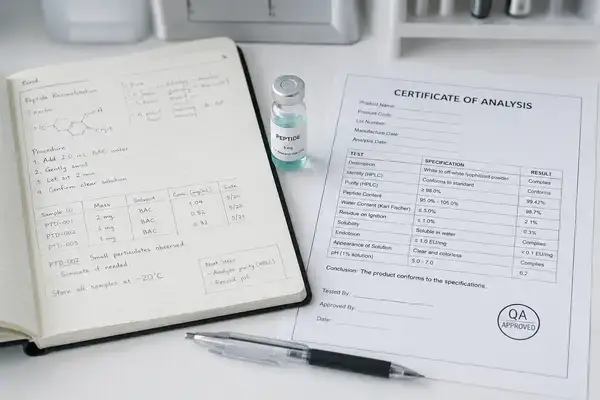
Sound documentation turns careful handling into reliable research. Keep the certificate of analysis on file for each lot, record lot numbers against every preparation, and maintain a simple storage log that captures dates, temperatures, and reconstitution details. A short standard operating procedure for receiving, storing, reconstituting, and aliquoting the blend gives every member of a research team a consistent reference and reduces the variability that creeps in when each person improvises. For a three-component material, this discipline is what keeps results comparable from one batch to the next.
Conclusion
Storing and reconstituting GLOW comes down to respecting the fact that a three-component blend never behaves like a single peptide. Build your handling routine around the least stable member, keep the lyophilized powder cold and dry, and protect it from light, humidity, and repeated temperature swings. When the time comes to reconstitute, work gently: bring materials to a controlled temperature, run the diluent down the vial wall, swirl rather than shake, and let all three components dissolve fully before any work begins. Calculate concentration from the per component figures on the certificate of analysis, aliquot to spare the blend from repeated freeze and thaw cycles, and label every portion with name, concentration, lot, and date. Pair that discipline with clear documentation and a simple standard operating procedure, and the blend stays reliable from batch to batch. Handle GLOW strictly as a research material, and the rest of the workflow follows.
FAQs
How should GLOW be stored before and after reconstitution?
Keep the sealed lyophilized blend in a freezer at around minus 20 degrees Celsius for long term storage, and shield it from light and humidity. Material in active rotation can sit refrigerated at 2 to 8 degrees Celsius for short periods. Once reconstituted, refrigerate the solution, aliquot it, and use it within a limited window, since the dissolved blend is far less stable than the dry powder.
What can be used to reconstitute a GLOW blend?
Bacteriostatic water is a common diluent for laboratory reconstitution of research peptides, though some bench protocols call for sterile water or a buffer instead. Whatever you choose, add it slowly down the inner wall of the vial rather than directly onto the powder, then confirm full dissolution before moving forward. Always select and handle the diluent in line with your research protocol and applicable safety guidelines.
How long does reconstituted GLOW stay usable?
A reconstituted blend is only as durable as its shortest lived component, so the working solution carries a narrower reliable window than the lyophilized powder. Keep it refrigerated, divide it into single use aliquots to avoid repeated freeze and thaw cycles, and label each portion with the reconstitution date so you can track its age. Reference the certificate of analysis and your own storage records when judging the window for a given lot.
Why should you avoid shaking the vial during reconstitution?
Shaking generates shear forces and foaming that can damage fragile peptide structure and disturb the copper bound component in solution. Swirl the vial gently or let it stand undisturbed instead, and give all three components time to dissolve at their own pace. Gentle handling at this stage protects the integrity of every downstream research step.
Why does a three-component blend need more careful handling than a single peptide?
A blend brings three separate stability profiles into one vial, and the whole preparation is only as stable as its least stable member. Storage, reconstitution, and concentration math therefore have to satisfy the strictest requirement among the components rather than an average across them. Calculate concentration from the per component figures on the certificate of analysis, not the combined total, to keep blended preparations accurate.